Pre-pilot · everything shown here is synthetic data
Two AI readers go first.People decide who gets in.
Kriteia reads each application: form answers, PDFs (decks included, when saved as PDF) and video from a direct file link. Two AI readers from different model families score it, and every score points to the page or passage it relied on, or says the evidence is missing. It ranks and keeps the record. A person decides.
The cropped screens are captured from the product on a synthetic run. The score card and the score table are illustrations. synthetic data
Kriteia in four figures
Collect · read · decide · explain
Four steps, and a human standing at the only one that decides.
Each step leaves something you can open and check. The applicant gets the reason.
- 01
Each application becomes one object the AI reads, with names taken out first
Names, teammates, institutions, contact details and the program's own gender terms are replaced before either AI reader sees the text. Each replacement is recorded, so the organiser can see exactly what the AI was shown. The text is checked again just before it is sent, and a leak stops the run.
What the applicant submitted
We run a two-week repair clinic in Coimbatore’s textile units, teaching line operators to diagnose and fix the machines they already use, and we publish every repair log so the next unit does not start from zero.
What the AI readers saw
We run a two-week repair clinic in [INSTITUTION]’s textile units, teaching line operators to diagnose and fix the machines they already use, and we publish every repair log so the next unit does not start from zero.
Live today
- CSV, with reconciliation
- Typeform, for responses after you connect
- Airtable
- PDFs, including decks saved as PDF, page by page
- Video from a direct file link, as a timestamped transcript
Not built yet
- Opening your own form from the product
- Google Forms
- Generic webhooks
- GitHub repositories
- Live-site capture
- Images
- XLSX
- Uploaded video files
- YouTube, Vimeo, Loom and Drive links
- PowerPoint and Word files
- 02
Two AI readers, from two model families, scoring the same published rubric
Claude Sonnet 5 and GPT-5.6 Terra score every application independently. Where they differ by two points or more on any criterion, the application is flagged, and the organiser can open both readers' scores, reasons and citations side by side. The ranking uses the average of the two; the flag stays on it.
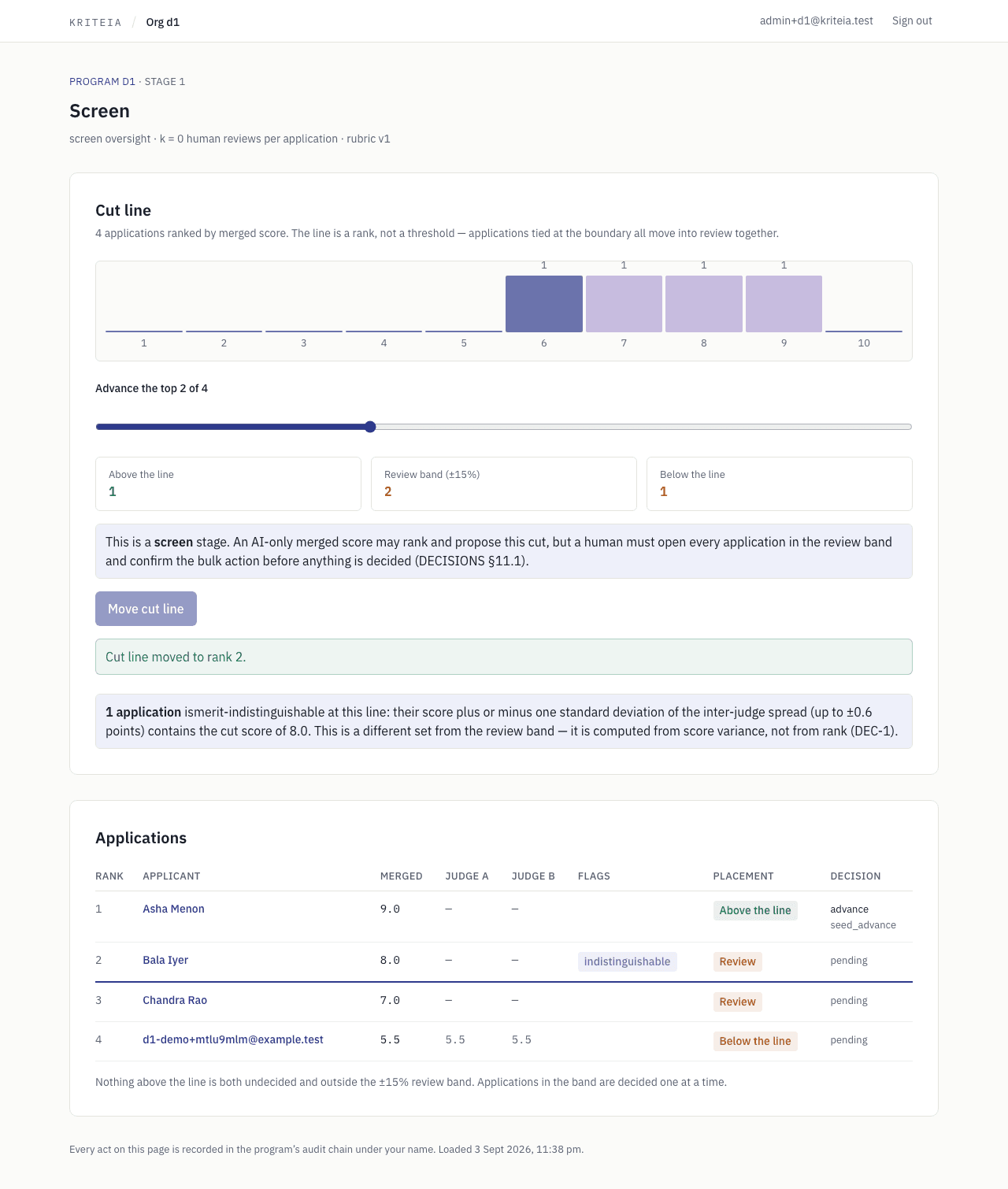
Three synthetic applications, ranked by the average score Rank Applicant Average Placement 1 Asha Menon 9.0 Review 2 Bala Iyer 8.0 Review 3 Chandra Rao 7.0 Below the line Synthetic applicants from our demonstration run. These scores were entered by hand.
- 03
The organiser draws the line, and the board argues back
Move the cut line and the board marks who is too close to the line to call: their score, plus or minus the spread between the two AI readers, still reaches the cut score. That set is computed from the scores and kept separate from the review band, whose applications have to be decided one at a time. Moving the line adds one entry to the record.
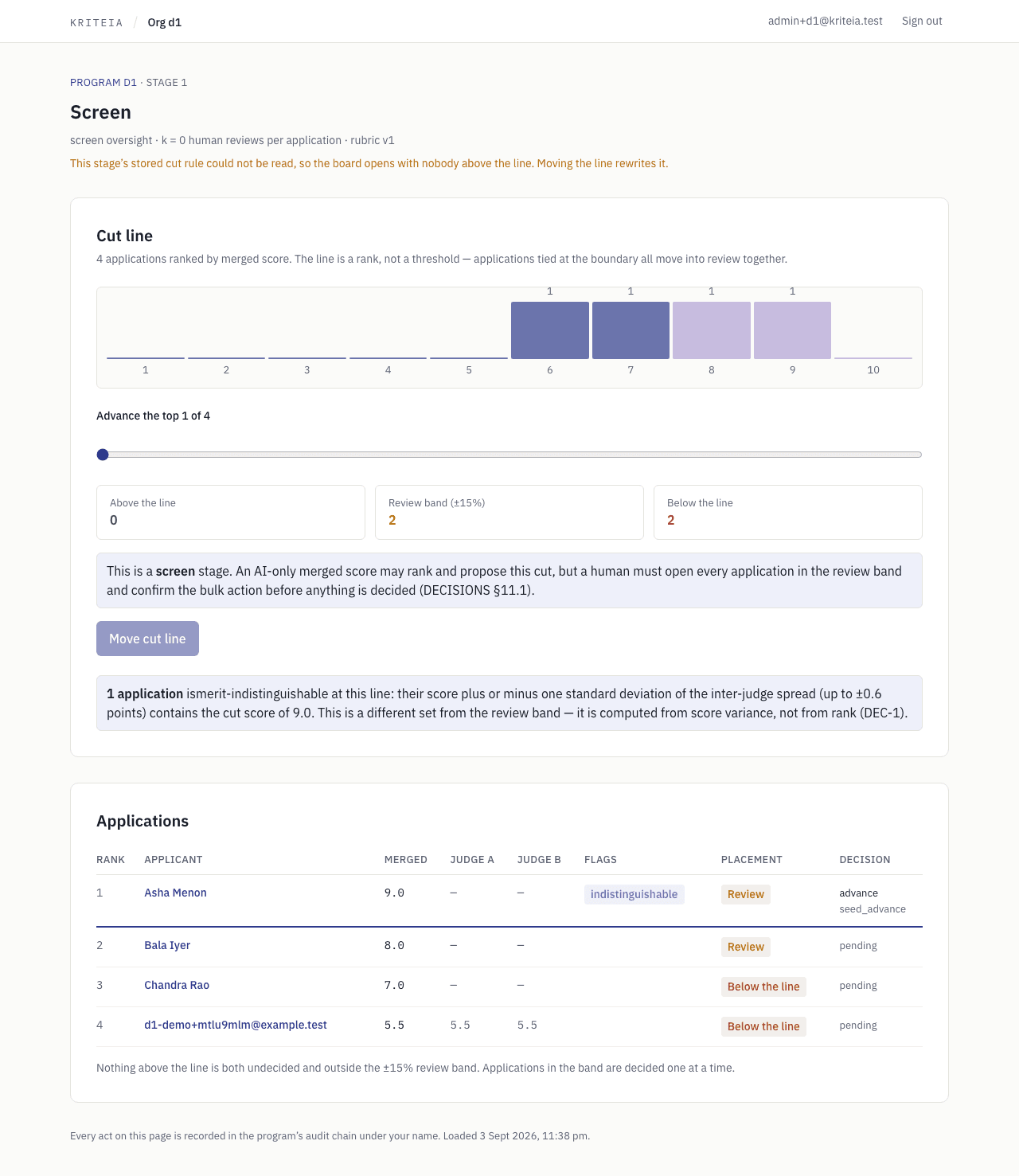
Synthetic data, generated for demonstration. A four-application run: three of the scores were entered by hand, and one came from deterministic test doubles standing in for the AI readers. indistinguishablemarks an applicant whose score band still contains the cut score.
- 04
Every decided applicant can be sent a reason, and a person releases it
Gemini 3.7 Flash drafts it — a third family, so the writer is never one of the readers. Every sentence has to name the criterion it came from and carry a citation that resolves against the evidence the AI readers scored. A sentence that cannot be traced is not sent; it goes to a person.
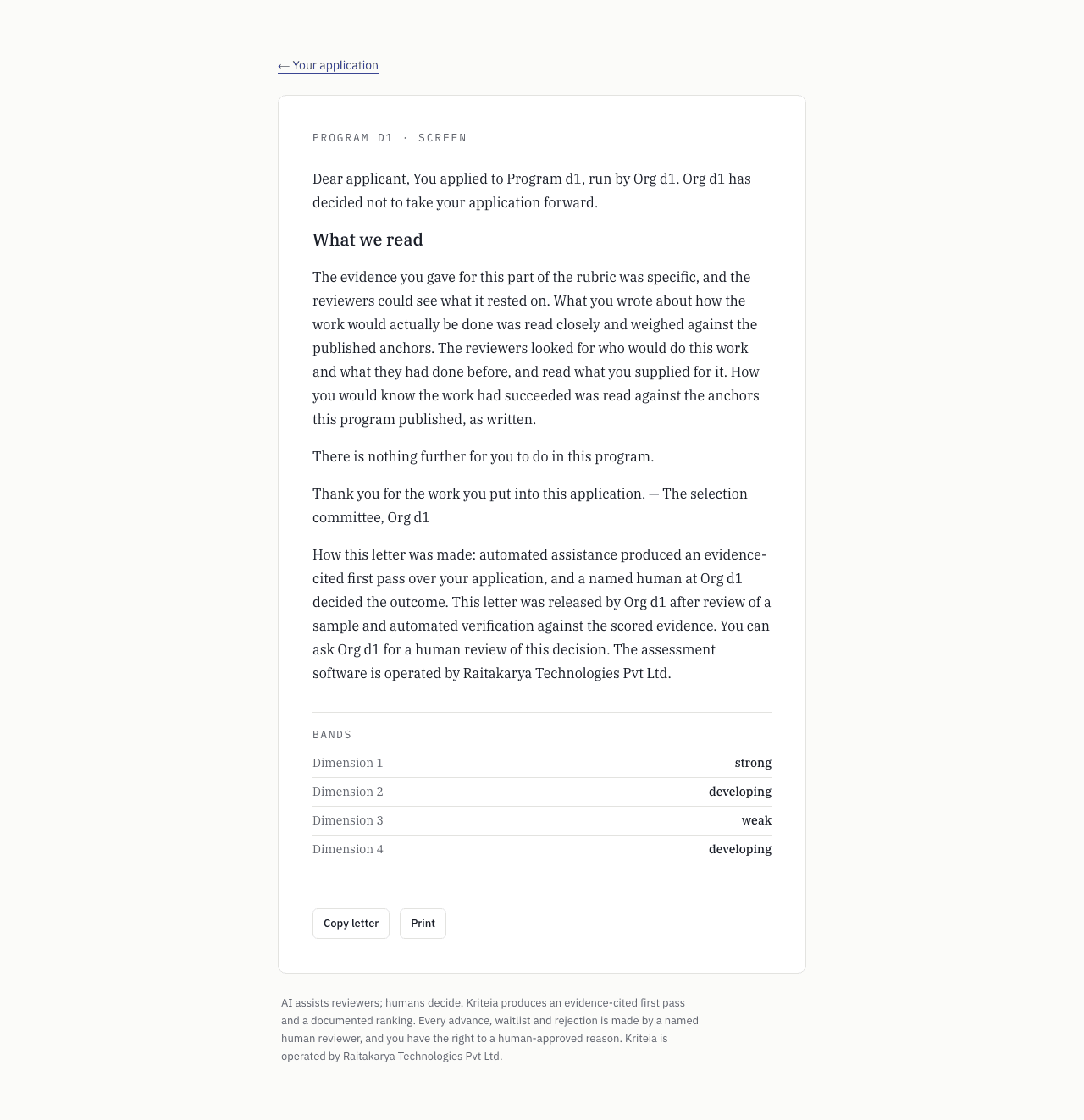
Synthetic data, generated for demonstration. A four-application run: three of the scores were entered by hand, and one came from deterministic test doubles standing in for the AI readers. No score, no rank, and no comparison to another applicant — ever. If the organiser turns band reveal on, the letter and the applicant’s own page show the same three words: weak, developing, strong.
Two AI readers
Two AI readers score it. Where they disagree, a person is told.
Click a citation below to mark the passage that score relied on. In the product, a citation opens the text it points to, and a PDF citation can open the file at that page in a new tab. This card is an illustration.
Criterion 2 · Execution evidence · weight 25
- Reader AClaude Sonnet 5 · Anthropic
- 8.0
- Reader BGPT-5.6 Terra · OpenAI
- 5.6
- Averageof the two readers
- 6.8
The two readers are 2.4 points apart on this criterion, so the application is flagged and appears in the organiser’s list of applications that need attention. The ranking still uses the average of the two.
Citations on this criterion
Evidence
We run a two-week repair clinic in Coimbatore's textile units, teaching line operators to diagnose and fix the machines they already use, and we publish every repair log so the next unit does not start from zero.
Cited for Execution evidence — who does the work, and on what.
Reader A · Claude Sonnet 5
Illustrative scores on a synthetic application. The two models named are the ones Kriteia uses today.VERSIONS §2
Not negotiable in code, copy or marketing
Three things the system is not allowed to do.
A fairness product is only worth the constraints it cannot talk itself out of. These three are enforced by the database and by automated tests, not by anyone’s good intentions — and each one is a thing we gave up being able to do.
- Law 0
No decision is recorded without a signed-in person.
The person deciding is taken from their signed-in session and cannot be passed in by any caller. Enforcement is revoked grants, a security-definer procedure, a fail-closed trigger and table ownership — deliberately not a row-level policy, because the service role bypasses those and a policy naming it would enforce nothing. Releasing a letter needs a signed-in owner or admin too.
No role is granted the right to insert a decision directly.
- The second law
No letter sentence reaches an applicant without a source.
Every sentence of every letter has to name the rubric criterion it came from and carry a citation that resolves against the evidence the AI readers scored. The five fixed sentences — greeting, outcome, next steps, sign-off, the transparency notice — must match their frozen text byte for byte. A sentence that cannot be traced is not sent. It goes to a person.
The checker is pure: no clock, no network, no randomness.
- The third law
The record is append-only and tamper-evident.
Decisions, cut-line moves, published rubric versions, AI assessments and letter releases are each added to a SHA-256 hash chain through one writer. Nothing on it is updated or deleted. A record that was altered, or an event quietly removed from the middle, fails verification — which is the difference between a log and an audit.
Verification reports the record intact, or names the break.
What a cycle actually costs, and what it still asks of you
The interesting number is not the one that goes down.
AI reading is cheap enough that it stops being the constraint. The row worth reading is the second one: the applications a person still has to decide one at a time, which grows with your program.
12,500
- Modelled AI cost
- ≈ ₹77,500–93,750About ₹6.2–7.5 an application at this setting.
- Applications a person must decide one at a time
- ≤ 3,750The review band: by default, 15% of the round on each side of the cut line. A bulk decision that includes one of them is refused.
- Letters read one at a time
- ≥ 438The sample the system draws from the clean remainder, and the approver does not choose. Every edge case is read individually on top of this.
- Applicants who can be sent a reason
- 12,500A letter is drafted for each decided applicant. None is sent until a person releases it.
Modelled at published list prices, ₹88 = US$1: the two AI readers’ share from recorded calls, the rest estimated. Not a quote, and not Kriteia’s price.Ground truth §6.5Ground truth §5.6
Questions that decide procurement
The answers are mechanisms, or they are not answers.
Where the honest answer is “not yet”, it says not yet. A selection engine that oversells its own certainty is arguing against itself.
Does the AI decide who gets in?
No, and it is not able to. A decision cannot be recorded without a person's identity taken from a signed-in session, and that identity is never a parameter any caller can supply — it is enforced by revoked database grants, a fail-closed trigger and table ownership. The AI produces a ranked, evidence-cited first pass. A program's last advancing stage must be a human review stage, checked by the database rather than by convention. Today the ranking comes from the AI alone: people set the line, decide the applications in the review band one at a time, and decide every outcome.
What stops the models being biased?
We take identity out and we measure for bias. We do not claim to have solved it. Names, institutions, contact details and the program's own gender terms are replaced before either AI reader sees the text, and the text is checked again just before it is sent, so a leak stops the run. Two readers from different model families score independently, so neither can rubber-stamp the other. Every change to the reading is measured for order sensitivity, length bias, identity leaks and resistance to hidden instructions. Several of those measurements fail today, and the methodology page prints every one.
How do you know the scores are any good?
Today, honestly, we do not — and the product says so rather than hiding it. Agreement between an AI reader and a human is certified against a gold set: at least a hundred applications, double-labelled by two people. That set does not exist yet, so every judge contract carries the status 'unvalidated' and every assessment is an advisory first pass. What does run on every change is a 98-application benchmark corpus with the metrics above. Its reference scores were written by us, not collected from human judges, so it measures the reading and cannot certify it: the scores are not yet checked against human judges.
Do applicants see their scores, or each other's?
Never. A letter carries narrative only — no score, no rank, no comparison to another applicant, and no reason code. If an organiser turns band reveal on, the letter and the applicant's own page show the same per-criterion word: weak, developing or strong. The boundaries are fixed platform-wide and are not configurable by the organiser. The setting is off by default.
What stops a hallucinated reason reaching someone?
Three things in series. Every sentence in a letter must name the criterion it came from and carry a citation that resolves against the evidence that was actually scored, and the fixed sentences must match their frozen text byte for byte. A letter that fails gets one regeneration, then goes to a person with a blocking flag. Finally a person at the organisation releases it, either after reading that letter, which is required for every edge case, or after reading a sample the system drew and the approver did not choose.
Where does the data live, and what about DPDP?
Application data is stored in Postgres in Mumbai, with row-level security on every table, scoped to the organisation, and no service-role key anywhere in the request path. To be read, application text is sent to AI providers (Anthropic, OpenAI and Google), and the audio of a linked video to Deepgram for a transcript. Consent is captured at the form, against a plain-language purpose statement, and checked in the database. Applications imported from a CSV file, Typeform or Airtable did not pass through that notice. Not built yet: automatic retention and erasure. Our privacy policy, terms and data-processing agreement are drafts no lawyer has reviewed, and we hold no SOC 2 or ISO certification.
Can you show me why one specific applicant was rejected?
Partly, today. The program's record holds every published rubric version, AI assessment, cut-line move, decision and letter release, in order and with times, and verification shows whether anything was altered or removed from the middle. Each decision is tied to the account of the person who made it, but the record does not show their name yet, and the page that answers 'why' for one applicant is not built yet.
The north star
“When the winners are announced, every other applicant should feel the right ones were chosen.”
We are looking for the first design partner: one real program, run with us at cost, in exchange for a case study and a calibration study we can publish.
Raitakarya Technologies Pvt Ltd · kriteia.ai